
Precise, technical analysis of how substrates and solutions interact in different environments is key to achieving optimal code quality and durability, but choosing the best possible solution for a customer’s specific needs requires more than just scientific testing.
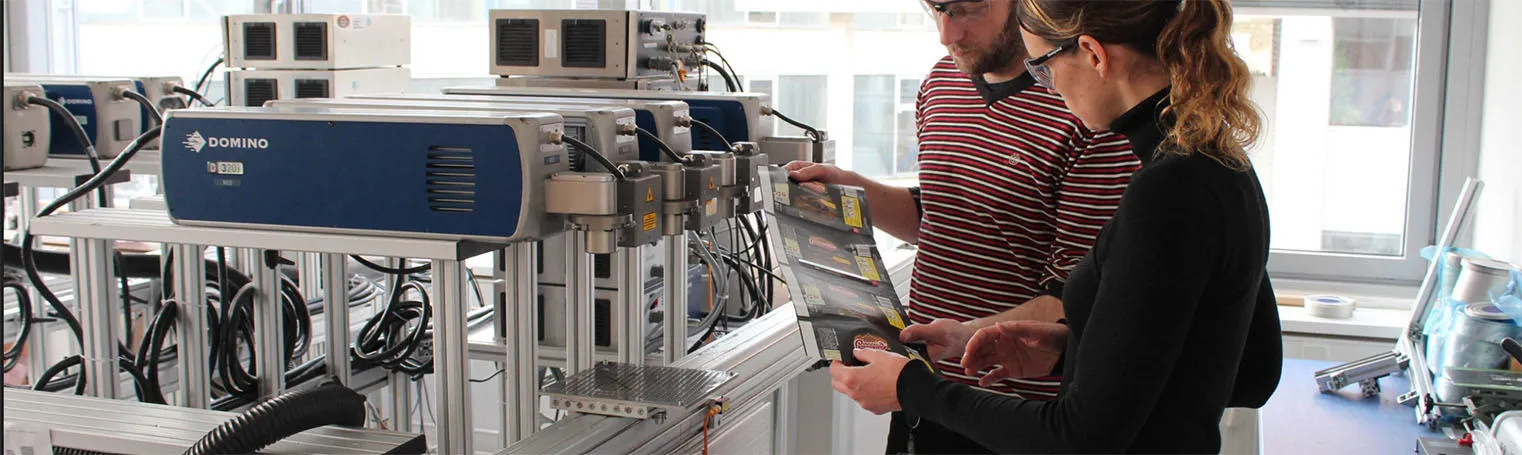
Domino’s specialist sampling teams provide strategic support to customers worldwide, using extensive packaging material testing to help identify and validate coding and marking systems for a wide range of packaging materials and applications.
The global ink sampling team, based in the UK, provides pre-sales support and testing across Domino’s ink-based technologies, including continuous inkjet, thermal Inkjet, piezo inkjet, and thermal transfer overprinting solutions. The ink sampling team works in unison with the laser sampling team, based in Hamburg, to provide strategic sample testing for Domino’s global customers.
Domino’s sampling teams help manufacturers select the right coding and marking systems through packaging material testing, QR code verification, compliance guidance, and solution validation for food, beverage, pharmaceutical, and industrial applications.
How do Domino’s sampling teams stay ahead of regulatory changes that could affect coding and marking solutions?
The teams work closely with the company’s dedicated compliance specialists to monitor regulatory developments, including evolving food packaging regulations, and assess their potential impact on product development, application testing, and coding solution selection.
In addition, Domino’s R&D team and sector specialists collaborate with many trade organizations to stay abreast of regulatory changes that might affect Domino’s solution development and sample testing capabilities. These include the British Coatings Foundation, the Retail Consortium, the British Printing Ink Federation, the Food and Drink Federation, and the Royal Society of Chemistry.
The teams develop guidance notes for Domino technicians based on this work to keep them informed of any changes to regulations. The benefit to customers is that all technicians are trained to recognize when a customer requests a solution that is not suitable for certain applications and will always offer alternatives.
Which regulatory developments are currently having the greatest impact on coding and marking applications?
The regulatory landscape for inks is constantly changing. With updates to the EU’s CLP (Classification, Labeling & Packaging) and REACH (Registration, Evaluation, Authorization, and Restriction of Chemicals), alongside changing food-contact packaging regulations including EuPIA’s Good Manufacturing Practice (GMP), the Swiss Ordinance (Swiss List), and the German Printing Ink Ordinance (GIO), this is driving increased scrutiny of ink formulations and, in many cases, necessitating reclassification or reformulation efforts.
Regulations vary between countries, so when working with larger customers selling into multiple regions, the sampling teams work closely with R&D and product management to ensure the solutions provided can be used across territories. Domino is also a member of the European Printing Ink Association (EuPIA).
Domino takes a proactive approach to ink reclassifications, developing alternative solutions with future regulations in mind, rather than reacting once the changes come in. For example, the teams have recently dealt with the reclassification of some chemicals which were historically used in food packaging.
By keeping up to date with upcoming legislation, Domino has been able to develop alternative inks. As a result, several inks are now globally suitable for food packaging solutions, ensuring Domino can always suggest alternatives to customers.
How do Domino’s sampling teams keep pace with evolving packaging materials and design trends?
Domino has longstanding relationships with many major global food and beverage companies at the forefront of packaging development, as well as with suppliers of packaging materials (paper, cartons, flexible film, etc.). As such, the sampling teams can actively source and test new packaging materials as they develop.
From Domino’s labs, the teams regularly reach out to customers developing innovative packaging solutions to obtain samples for testing as they are being developed. By working with customers this way, Domino ensures suitable coding and marking solutions are available for customers using these or similar substrates in the future.
What does the sample testing process look like when supporting a customer application?
Domino evaluates substrates, production environments, and application requirements before recommending coding and marking systems. Domino tests samples for durability, readability, adhesion, and performance under real-world conditions.
For laser applications, the assessment also considers how different materials absorb laser energy and how variations in substrate composition may affect code quality and permanence. Even materials that appear identical can respond very differently during coding because of composition variations, making sample testing an important part of solution selection.
Once teams have information on the substrate and application, they can refer to previous sample tests to find possible solutions. Domino maintains a searchable database of previously coded materials, as well as a catalog of results from extensive in-house testing, including results from a wide variety of substrate tests across ink and laser technologies. This enables the teams to compare how substrates have previously performed across multiple coding technologies, helping identify the most suitable solution for each application.
Once a solution has been selected and a sample has been run, the teams carry out a range of different tests to check the effect on the substrate and code durability.
Sample testing may include:
- Rub and scratch testing
- Durability assessment
- Contrast testing
- Sterilisation testing
- QR code verification
- Barcode verification
For ink samples, we carry out rub, scratch, and swipe testing to check code resilience and drying time. For some flat substrates, an automated taber tester with a weighted reciprocating arm applies predefined pressure to the printed sample and checks for ink transference. The teams also assess factors such as contrast, durability, machine readability, and overall code quality to ensure the selected solution meets application requirements.
In the sample labs, specialist equipment checks code quality in different environments, including a high-speed conveyor system and an industrial team sterilizer to test code adherence for samples requiring a retort. The teams also carry out barcode, QR code, and Data Matrix code verification using different 2D-code verifiers.
How are Domino’s global sampling resources connected to support customers worldwide?
Sampling is often a collaborative process, with the teams working closely alongside customers to evaluate materials, review results, and refine recommendations before implementation. Both ink and laser sampling teams collaborate to ensure the recommended solution best fits the customer’s needs.
Domino’s sample testing labs operate globally, providing expert advice and sample testing to subsidiaries and distributors regardless of location. Both Domino’s ink and laser sampling labs can also offer virtual demonstrations, with the ability to switch between labs to show the customer both laser and ink sampling in a single appointment.
In addition, some international offices, including those in India, China, North America, Mexico, and Germany, have regional labs and some sample testing capabilities. Providing sample testing in the country of origin has the advantage of saving time and air miles, though ultimately, the decision of where to test the sample is based on what is best for the customer.
When advising on solutions pre-test, the teams work from the same shared database of previous samples and solutions, ensuring all customers receive the most up-to-date advice and support. The extensive database includes information on materials previously submitted for testing, as well as results from in-house experimental testing of new substrates. Through the database, international labs can access reports and photos of final codes and test codes for any given substrate, along with lab testing results and working notes from experienced technicians.
How are sustainability trends influencing sample testing and coding solution development?
In recent years, sampling teams have noticed a significant increase in requests for recycled cardboard samples. Cardboard made from recycled paper varies in quality and color, which can lead to lower-quality print if the wrong type of ink is used. These samples require dark, viscous ink that sticks to the substrate without spreading. This is particularly important when printing barcodes, where code quality is critical.
Conversely, customers increasingly demand recyclable packaging solutions. This requires coding solutions that support recyclability without compromising the recycling stream. In response, Domino has developed a range of vegetable-oil-based ink solutions for recyclable cardboard, as well as laser solutions that support recyclability.
Mono-material plastic films made from polyethylene and polypropylene, including BOPP (biaxially-oriented polypropylene) film for food packaging, have also increased. These products replace traditional multi-material plastics because they are easier to recycle; however, they also require different coding solutions than multi-material plastic films.
More customers are now exploring reusable packaging. This requires an ink coding solution that will stay on a product throughout its use but can be removed once the packaging is returned. Domino has a longstanding relationship with many international breweries for whom reusing glass bottles and kegs has been standard practice for many years. Washable inks have been developed specifically for this use and can be removed with a caustic water bath, ready for recoding time and time again.
Preparing for what’s next
Sustainability in packaging is likely to be a recurring theme for many years to come, and the teams are already anticipating further regulatory changes concerning the use of recycled and recyclable materials.
Domino’s experts will continue to monitor emerging packaging trends and regulatory requirements, ensuring customers have access to coding solutions that support both current and future packaging innovations.
The teams actively obtain samples of new materials from customers, partners, and other industry leaders to help ensure that both ink and laser coding solutions are available when customers need them.
Discover how Domino’s services and solutions support customers worldwide, from application testing and compliance guidance to implementation, training, and ongoing technical support.