
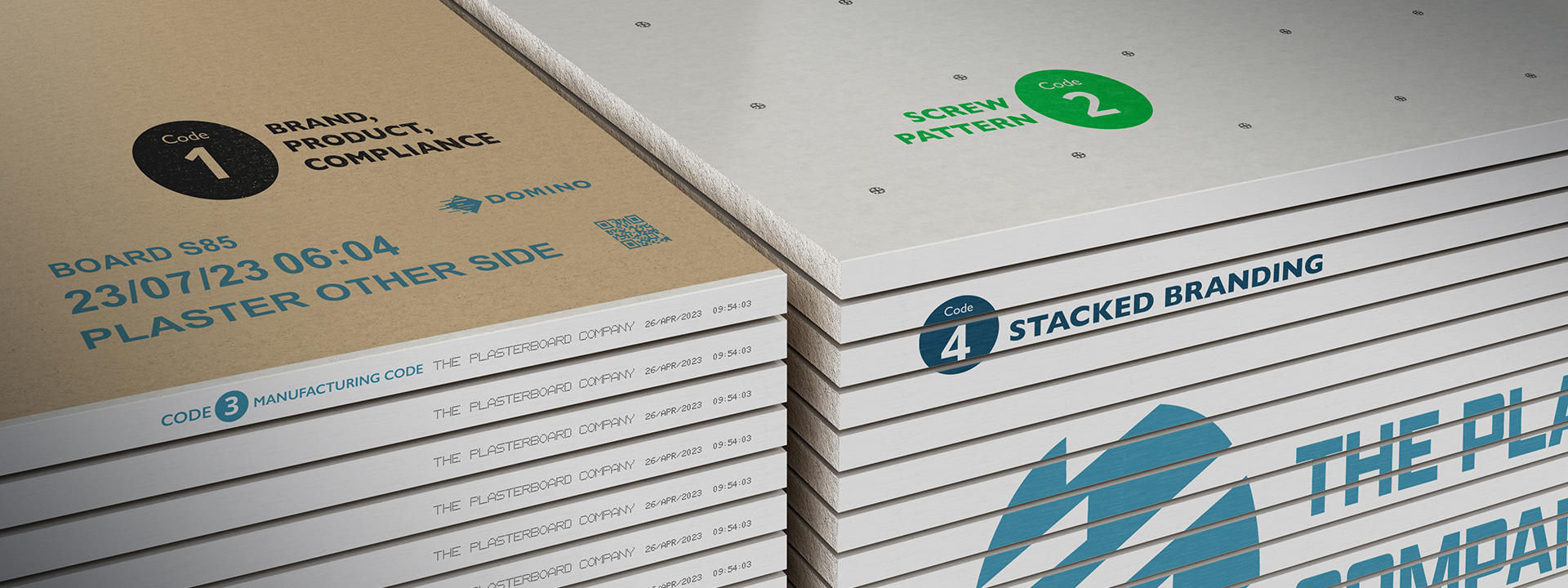
Change is coming – this blog will highlight what building and construction materials manufacturing companies need to know about printing EU CPR compliant GS1 2D codes without compromising manufacturing productivity.
High-volume, hot, dusty, and relentless – this is the reality in building and construction materials manufacturing. A single plasterboard line can run non-stop at up to 140m/min, churning out millions of square meters each year.
Fast-paced manufacturing lines sit against a backdrop of slim margins, tight deadlines, and continued industry expansion.
The unwritten rule has always been to keep the line running no matter what, but new regulations are changing the playbook and could jeopardize the drive for efficiency.
What is the scope of construction product rules for manufacturers?
New regulations including the EU Construction Products Regulation (EU-CPR 2024) are pushing for more advanced material traceability, including digital product passports (DPPs) and machine-readable codes, to help ensure building safety, accountability, and sustainability.
Consistent data standards will help to enable the consistent identification and sharing data related to building and construction materials. While there is currently no one rule related to how the information should be shared, GS1 2D codes with Digital Link technology offer a universally recognized standard which can bring some much-needed clarity to the industry.
Each GS1 2D code (GS1 QR or GS1 DataMatrix) will link to the product’s brand name, key attributes, and unique Global Trade Item Number (GTIN), as well as providing the ability to access other product information, such as usage and installation instructions, durability, and maintenance requirements.
However, the use of GS1 2D codes on construction products adds complexity to product coding and may require line upgrades. This is a significant concern for manufacturers of building and construction materials.
Challenges of printing GS1 2D codes in construction manufacturing environments
It is imperative that 2D codes are printed correctly to ensure they can be scanned effectively; the harsh, fast-paced nature of construction environments can pose a challenge. Existing coding equipment and production lines may not be optimized for 2D code printing, necessitating line upgrades.
Manufacturers upgrading their lines to manage advanced variable data 2D codes will need to consider:
- Substrate variability: Construction materials such as wood, aggregates, and bagged products may vary in surface texture and consistency, making reliable coding more difficult.
- Line speed vs print resolution: Fast line speeds may come at the expense of print quality and scan-ability.
- Dust and contamination: Dust-heavy environments can affect print quality and printer performance, increasing the risk of waste and downtime.
- Cost of errors: Construction materials manufacturing lines run at very high speeds, compounding the cost of errors and associated waste.
- Printer downtime: The true cost of downtime goes beyond wasted raw materials – including lost sales, wasted labor, and downstream disruption.
Key concerns when upgrading construction materials manufacturing lines for GS1 2D codes
How much does it cost to upgrade a printer for 2D serialization?
While in the past the cost of implementing 2D codes may have been prohibitive, it is becoming more manageable. Adoption in other industries, such as pharmaceuticals, has accelerated development and driven down costs.
Does printing a 2D barcode increase the possibility of downtime?
New coding systems are specifically engineered for harsh, dusty environments such as those found in building and construction materials manufacturing. Far from introducing risks, modern industrial inkjet and laser systems are built to effectively apply GS1 2D codes in hostile environments.
Does printing 2D codes slow down production lines?
Printing technology has evolved to deliver higher resolution 2D codes at high speeds, with add-on solutions such as automation and machine vision helping to improve productivity and reduce waste.
How can manufacturers avoid errors when implementing 2D codes?
Regulatory 2D codes must be verified for accuracy and readability, so inline vision systems are a crucial consideration. Vision systems can automatically verify 2D codes at speeds matching production line printers and reject substandard products before they leave the line.
Product handling is another critical factor. Variations in product positioning, shape, and distribution can affect final code quality. Combined product-handling solutions, such as integrated coding systems for extrusion products, as well as bespoke solutions, are widely available to support 2D code applications.
Is 2D code marking equipment difficult for operators to use?
Modern coding systems are designed to be straightforward for production line operatives to use. Intuitive interfaces, remote monitoring, and augmented reality-enabled support mean that day-to-day operation doesn’t require specialist coding knowledge, and help is available quickly if an issue arises.
The availability of automated coding solutions can further simplify the process. With coding automation, machines can integrate with manufacturers’ ERP and MES systems to automate product coding, reducing the need for manual data entry, and reducing the risk of coding errors.
Getting your 2D coding project right from day one
Domino’s solutions for the building and construction materials sector include the latest industrial printers and vision systems designed to print and verify 2D codes in harsh production environments, as well as specialized, turnkey solutions tailored to sector-specific requirements.
That said, all production lines are different, and there is no ‘one size fits all’ solution. From a manufacturing side, any new installation is bound to come with challenges, and these can only be overcome by forming a close relationship with a supplier who can help guide you through the process.
At Domino, we have many years of experience in project management and working with customers to understand their needs and priorities and find the appropriate solutions for their specific needs.
Domino’s offering also extends beyond the factory setting, with worldwide helpdesk and field support and fault monitoring, helping to minimize the risk of downtime. Our service and support packages also provide access to on-site assistance and remote, augmented-reality-enabled guidance from technical experts.
Our range of industrial printers, designed for printing 2D codes in harsh production environments, combined with automation, connectivity, and support solutions, provide the technology and support that building and construction materials manufacturing companies need to fully embrace advanced variable-data printing with 2D codes.
Beyond compliance: The foundation for smarter manufacturing
To the uninitiated, compliance equals cost. However, better product identification can unlock increased efficiency and add value to the downstream supply chain – and the benefits for building materials manufacturers should not be overlooked.
When printed with a 2D code, each construction product becomes a smart object, scannable at any point in the manufacturing or construction process. A simple scan can access a digital profile, which shows when it was created, the line it originated from, its material composition, and its intended use.
For manufacturers, this can be used to provide production insight, error identification, and accurate root cause analysis. Beyond the factory, this product information provides a gateway to greater collaboration and efficiency up and down the supply chain.
Today, there is a compelling opportunity to look beyond the perception that compliance is just a cost and recognize that building and construction materials manufacturers can deliver significant value throughout a connected and collaborative supply chain.
Having a better understanding of the challenges and selecting a partner that recognizes the wider potential of advanced variable data 2D codes can give manufacturers the edge in a competitive industry.
Find out more about the additional benefits of implementing GS1 2D codes in construction materials manufacturing, beyond compliance.