
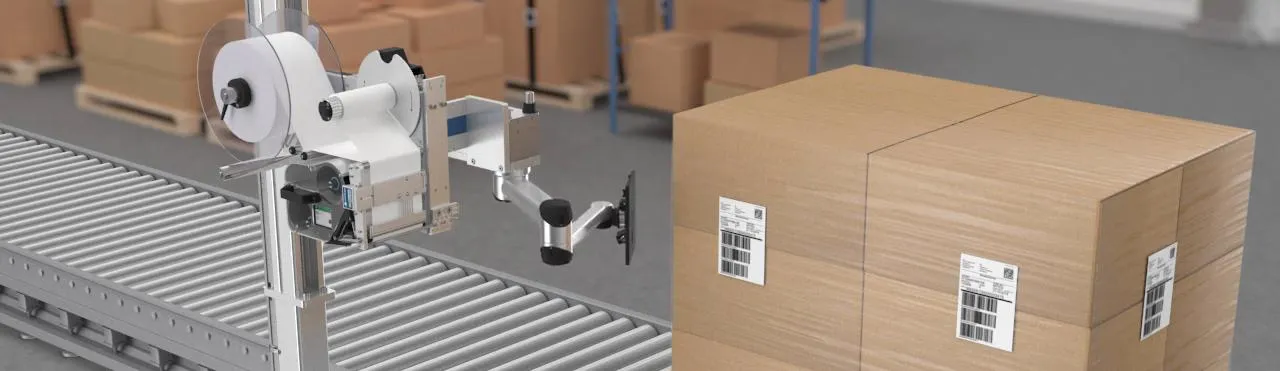
Modern logistics operations demand pallet labelling systems that can be seamlessly integrated into an automated production process to deliver consistent, accurate, and compliant labels despite the realities of varying pallet sizes, positions, and conditions. Domino’s Mx350i-eP electric pallet labeller is a flexible, intelligent, and highly automated solution that helps manufacturers address these challenges.
Designed for Real-World Challenges
GS1 standards require a unique code to be applied to two adjacent sides of a pallet. But what happens, if the label is crumpled, or damaged so that the code doesn’t scan? To prevent the pallet being rejected many businesses are now looking to adopt a four-label approach, applying two identical labels to each side to help ensure compliance, by thus reducing the risk of label loss or damage during transportation and handling.
Although many pallet labelling systems can support this requirement, they often rely on manual intervention to manage variations in pallet size, shape, and positioning. With increasing demand for greater automation the challenge becomes significantly more complex and these limitations can create inefficiencies.
According to Claes Lindh, Senior Business Support Manager at Domino Printing Sciences, pallet labellers must be designed to take operational realities into account rather than assuming perfect conditions.
"Very few pallet labelling systems can provide consistent, flexible, safe, and automated labelling in real-world logistics applications,” says Lindh. “The reality is that pallet labelling isn’t clean or perfect. Pallets vary, and positions change. We don’t ignore that reality – we design for it."
Claes Lindh, Senior Business Support Manager, Domino Printing Sciences
Automated Multi-Label Application
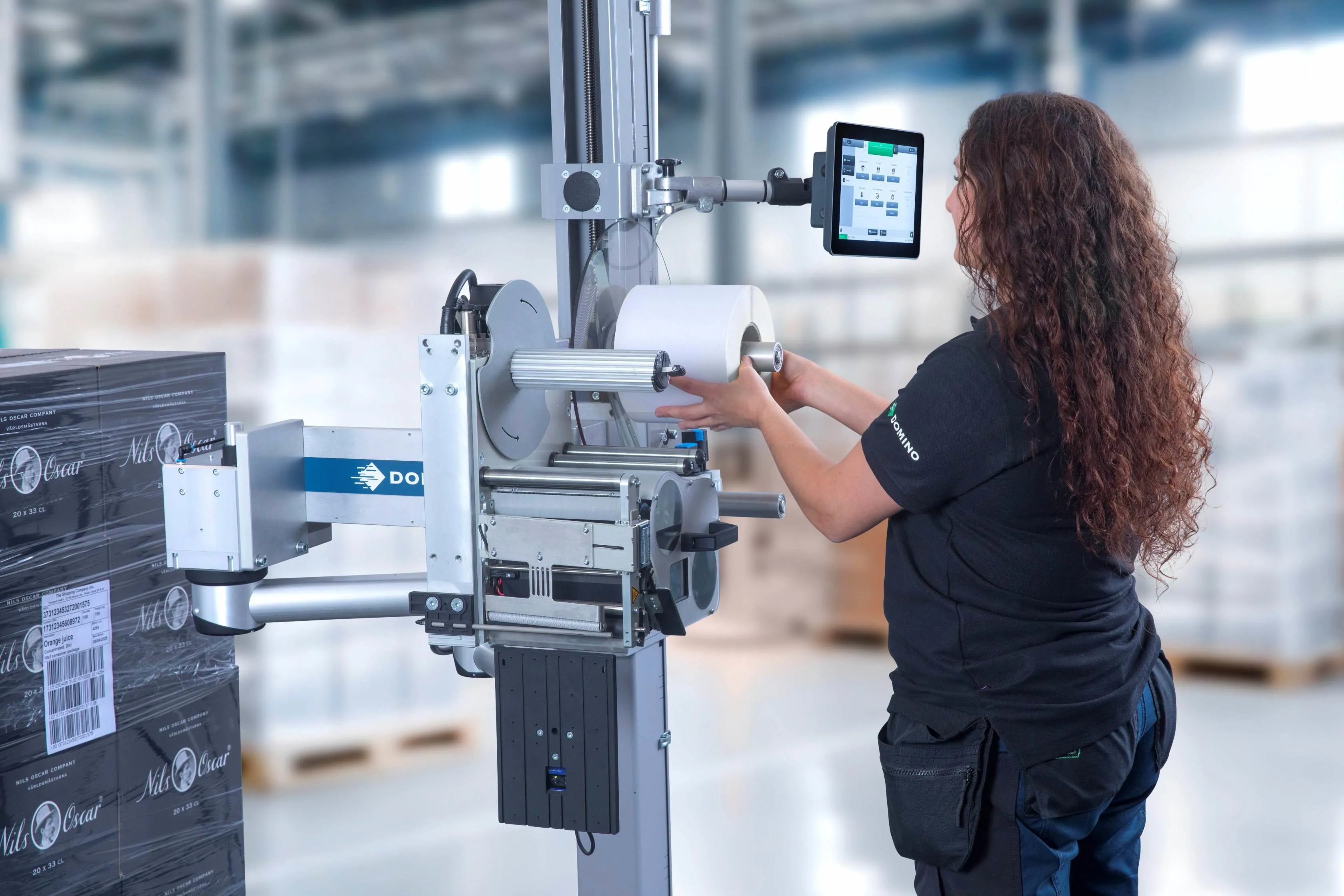
At the heart of the Mx350i-eP is a fully electric, three-axis, programmable applicator arm capable of performing a range of standard application movements, while also supporting custom and bespoke motion paths for specialised pallet labelling requirements.
A programmable motion path enables the automated application of two labels on each of two adjacent sides of a pallet. Designed to support compliance with the GS1 standard for Serial Shipping Container Codes (SSCC) while reducing the likelihood of label loss or damage during shipment, this functionality automates a process that has traditionally required manual operator intervention.
Once selected through the user interface, the system automatically follows the predefined motion sequence for every pallet, helping manufacturers maintain consistent application quality while reducing operational effort.
Flexibility Through Electric Applicator Technology
The adaptability of the Mx350i-eP is driven by its fully electric, programmable applicator arm, which has been engineered to handle irregular, inconsistent, and non-standard pallets that can be challenging for more rigid pallet labelling systems.
This flexibility enables manufacturers to modernise their production to accommodate a wide range of pallet configurations with increased automation and improved labelling accuracy. Furthermore, the all-electric technology enables significantly improved safety features.
"The level of adaptability is enabled by the Mx350i-eP’s fully electric, programmable pallet label applicator arm, which provides reliable labelling of irregular, inconsistent, or non‑standard pallets that would challenge rigid applicators,” says Lindh. “By comparison, traditional systems typically rely on fixed, rigid stroke paths, with limited adaptability and no true custom motion capability. They expect the pallet to conform to the machine. The Mx350i-eP does the opposite."
Intelligent Safety for Seamless Integration
The Mx350i-EP has been designed with integrated safety features that allow for operation without needing a traditionally required additional safety guarding. These improved safety features simplify integration into existing pallet labelling lines and allow easy access to the machine. The pallet label applicator arm is engineered to minimise pinch points and has built-in collision detection functionality. In the event of an unexpected obstruction, the arm automatically stops and safely moves away, helping to protect both personnel and equipment.
Reduced Compressed Air Consumption
Standard applicator pads use compressed air to pick up, hold, and apply labels. To reduce the use of compressed air to a minimum, Domino has introduced an electric applicator pad which requires compressed air only for label pick‑up. Labels are held in place by integrated fans and applied by using a tamp mechanism.
As a result, air usage can be reduced by up to 90% compared to conventional pallet labelling systems.
For pallet labelling applications where a purely tamp-based label application is not suitable our standard application pads utilising a tamp-and-blow system remain an option.
Into the Future of Logistics
As supply chains will continue to become increasingly automated, solutions capable of adapting to automated processing conditions will play an important role in helping businesses achieve consistent and efficient identification across their logistics operations.
With enhanced automation, improved flexibility, reduced air consumption, and intelligent safety features, the Mx350i-EP demonstrates Domino’s focus on helping manufacturers overcome practical pallet labelling challenges while supporting compliance, efficiency, and operational reliability.
If you’re interested in reading more about warehouse automation: Automated warehouse systems in modern supply chains | Domino Printing UK