

Supporting the production of next-generation extended content labels
As demand for extended content labels (ECLs) featuring variable QR codes to support connected packaging, product authentication, and consumer engagement initiatives grows, converters face the challenge of producing increasingly complex labels efficiently, economically, and at scale.
Analogue printing technology will struggle to meet the requirements of shorter promotional print runs, fast artwork changes, and variable data without compromising operational efficiency.
The challenge with conventional multi-layer label printing
Production of extended content labels is more complex than producing conventional pressure-sensitive labels.
Creating extended content labels using traditional, analogue production processes can be time-consuming and labour-intensive, requiring several passes of the substrate through flexo presses, with careful registration of all layers during assembly and finishing to ensure a high-quality label. The complexity of the process means that it is often only feasible to produce high-volume runs of a single artwork.
What’s more, brands are increasingly seeking more personalised and connected packaging experiences, which is adding to the challenge. Conventional workflows can be difficult to scale efficiently when incorporating variable elements, and high-resolution digital inkjet is becoming a key technology for converters supporting brands with variable multi-layer label requirements.
Why digital multi-layer label printing?
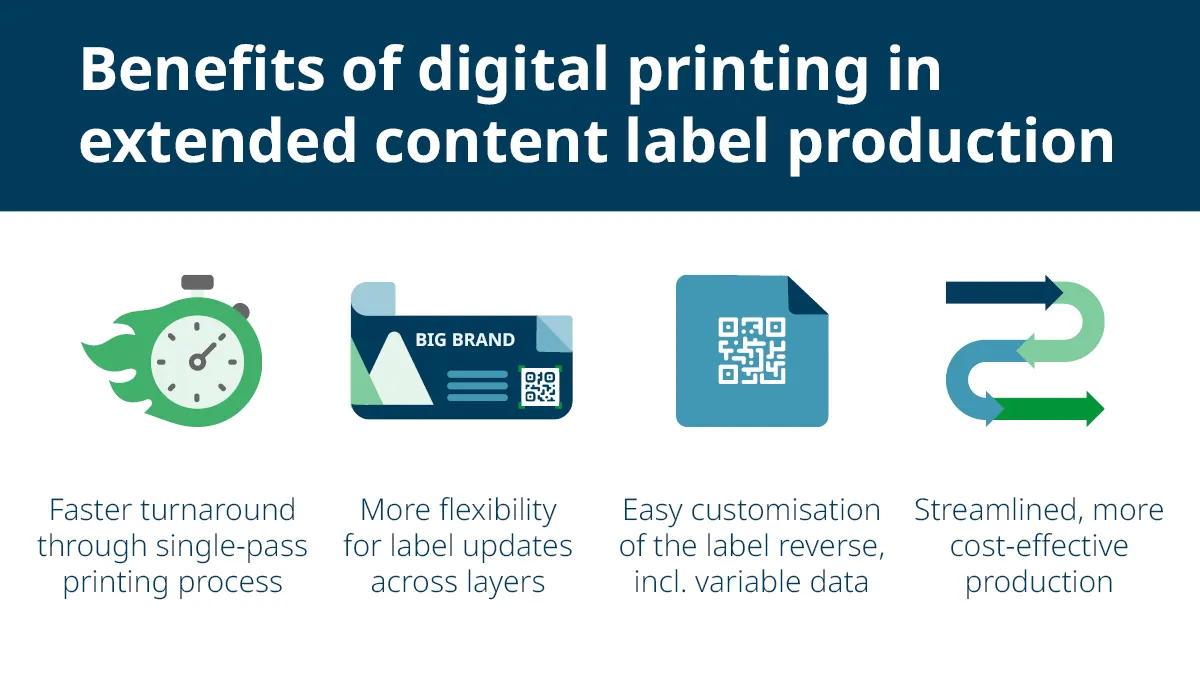
Digital workflows can overcome some of the challenges in producing short run, or variable extended content labels and deliver increasingly complex multi-layer label applications efficiently and cost-effectively.
Using digital printing technology, converters can
- Produce shorter runs of label variations in a single language, rather than printing high volumes of labels featuring multiple languages, to minimise substrate and ink use and reduce costs for brands.
- Update labels with revised regulatory or promotional content without costly platemaking, gaining greater flexibility and faster turnaround while reducing waste from label obsolescence.
- Print variable elements, such as alphanumeric or 2D codes, onto the adhesive reverse or inner layers of an extended content label inline.
- Generate, manage, and print serialised data to support product authentication, anti-counterfeiting initiatives, supply-chain traceability, and personalised consumer engagement.
- Create affordable peel-and-reveal label promotions and customer competitions for brands and product lines with lower label volumes.
In short, converters that can produce multi-layer labels digitally can deliver higher-value services to customers and gain an edge over competitors constrained by analogue production processes. Beyond improving operational efficiency, digital multi-layer label production enables converters to pursue higher-margin applications and strengthen long-term customer relationships.
A new approach to multi-layer label printing
To meet these evolving customer demands, converters need production workflows that combine multi-layer construction and variable data printing without adding unnecessary complexity.
In cooperation with Grafotronic and French label converter LP2i Etiquettes, Domino has devised a digital approach to extended content label production, in which the face and reverse of each layer can be printed in a single pass.
This new hybrid process features a Domino K600i monochrome inkjet printer and Domino N730i Integration Module alongside Grafotronic converting, cold foiling, die-cutting, and buffer stations.
The solution enables the K600i to print directly onto the delaminated label adhesive in monochrome, then relaminate and print the label face in full colour with the N730i Integration Module in a single pass. This reduces the number of unwinding and rewinding steps needed to produce each printed layer. Offline Grafotronic finishing equipment combines the layers into multi-layer labels using in-register lamination and hot foiling.
The result is a faster, more efficient production workflow for multi-layer labels, allowing every label layer to be customised without compromising flexibility or reliability. This innovative production workflow empowers brands and converters to expand the possibilities of extended content and peel-and-reveal label formats.
Hear about LP2i Etiquettes’ experience of digital multi-layer label printing with Domino in the video below:
The future of extended content labels
Extended content labels are evolving beyond compliance tools into platforms for consumer engagement, authentication, and connected packaging. As demand for these applications grows, converters will need production workflows that deliver greater flexibility, personalisation, and efficiency.
Digital printing makes this possible, enabling converters to support increasingly sophisticated label applications while creating new opportunities for differentiation and growth. By reducing setup costs, minimising waste, enabling shorter production runs, and creating opportunities for higher-value applications, digital printing can make extended content label production significantly more profitable for converters.
Speak with our specialists to explore how digital workflows could enhance your extended content label applications.